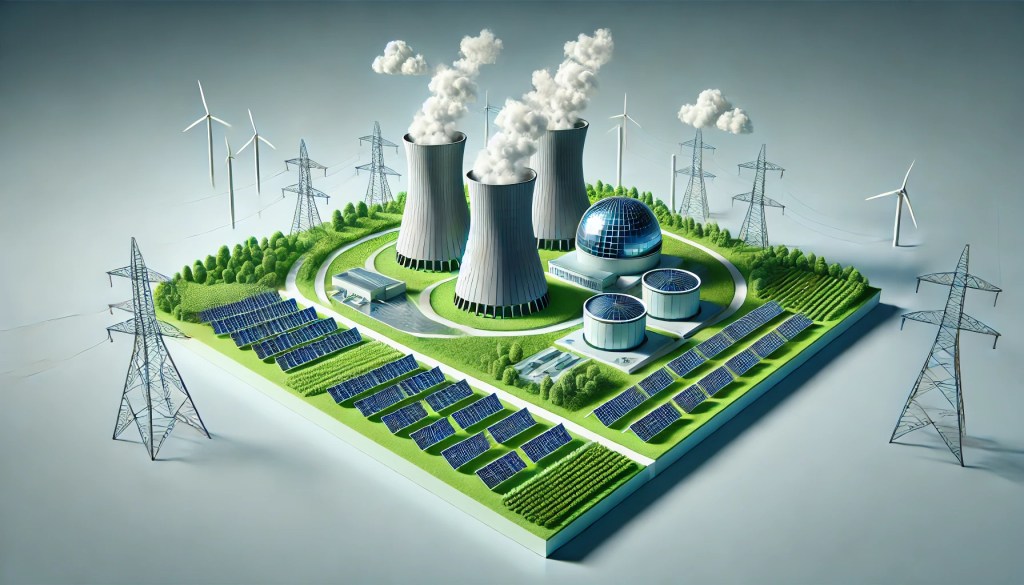
How Much Does a Nuclear Power Plant Really Cost? A Global Comparison of Cost per Megawatt
Few energy technologies spark as much debate as nuclear power. Once hailed as the pinnacle of modern engineering, then feared after disasters like Chernobyl and Fukushima, and now cautiously reconsidered as a low-carbon alternative in the fight against climate change—nuclear energy refuses to fade from the global energy conversation. But there’s one key question that often clouds the debate: how much does nuclear power really cost?
This article presents a comparative, data-driven overview of the capital expenditure per megawatt (MW) installed capacity across a selection of large-scale and small modular reactor (SMR) projects worldwide. From state-backed mega-projects in Egypt and China to troubled Western builds in the US and UK, the numbers tell a compelling story of contrasts, challenges, and potential.
Why Focus on Cost per Megawatt?
In large infrastructure projects, comparing total project costs is only partially helpful. What matters more is how much capacity you get per dollar invested, which is best expressed as cost per installed megawatt (USD/MW). This allows us to compare projects of different scales and technologies on a more equal footing.
While operating and decommissioning costs also matter in the lifecycle of a nuclear plant, construction costs dominate capital decisions and are often the deal-breaker for investors or governments.
Global Cost Comparisons: Recent Nuclear Projects
Here’s a selection of notable recent or ongoing projects around the world, ranked by estimated cost per MW:
| Project | Country | Reactor Type | Total Cost (USD) | Capacity (MW) | Cost per MW (USD) | Status |
|---|---|---|---|---|---|---|
| Taishan 1 & 2 | China | 2× EPR | $8.7 billion | 3,300 | $2.64 million | Operational |
| Barakah 1–4 | UAE | 4× APR-1400 | $24–32 billion | 5,600 | $4.36–5.71 million | Operational |
| Rooppur 1 & 2 | Bangladesh | 2× VVER-1200 | $12.65 billion | 2,160 | $5.86 million | Under construction |
| El Dabaa | Egypt | 4× VVER-1200 | $28.75 billion | 4,800 | $5.99 million | Under construction |
| Akkuyu 1–4 | Turkey | 4× VVER-1200 | $24–25 billion | 4,456 | $5.38–5.61 million | Under construction |
| Sizewell C | UK | 2× EPR | £20–35 billion | 3,260 | £6.1–10.7 million | Planning |
| Flamanville 3 | France | 1× EPR | €19.1 billion | 1,650 | €11.6 million | Near completion |
| Vogtle 3 & 4 | USA | 2× AP1000 | $35 billion | 2,228 | $15.7 million | Operational |
| Hinkley Point C | UK | 2× EPR | £41.6–47.9 billion | 3,260 | £12.8–14.7 million | Under construction |
| NuScale SMR (cancelled) | USA | 462 MWe SMR | $9.3 billion | 462 | $20.1 million | Cancelled |
| TerraPower Natrium | USA | 345 MWe SMR | $4 billion | 345 | $11.6 million | Construction phase |
| Rolls-Royce SMR | UK | 470 MWe SMR | £1.8–3 billion | 470 | £3.8–6.4 million | Development |
Key Observations
1. Gigantic cost spread between countries
Developing countries like China, Bangladesh, Egypt, and the UAE consistently achieve lower costs per MW—often in the range of $2.5 to $6 million per MW. In contrast, Western countries like the US and UK regularly exceed $10 million per MW, with some projects like Vogtle hitting over $15 million per MW.
Why this disparity?
- Labor and construction costs are much lower in non-Western countries.
- Regulatory and permitting processes are streamlined or more politically centralized.
- Standardized reactor designs are often reused (e.g., multiple VVER-1200 or APR-1400 installations).
- State backing and financing models reduce financial risks and delays.
2. Western projects suffer from cost overruns and delays
Projects like Hinkley Point C and Vogtle 3 & 4 have been plagued by years of delays and ballooning budgets. In both cases, early optimism about construction timelines gave way to complex reality: supply chain issues, safety-related redesigns, and skills shortages.
These challenges contribute not only to higher absolute costs, but to investor hesitation and political opposition.
3. SMRs aren’t cheap (yet)
While Small Modular Reactors are promoted as a cost-saving innovation, the first commercial implementations remain very expensive—partly due to high R&D investments and lack of mass production.
For example:
- NuScale’s cancelled SMR ended up costing over $20 million per MW.
- TerraPower’s Natrium project is expected to cost $11.6 million per MW—still higher than some large reactors.
There is potential for cost reduction through serial production and standardized designs, but no SMR project has yet demonstrated clear economic superiority.
What Does This Mean for Policy and Investment
- Levelized Cost of Electricity (LCOE): While upfront capital is high, nuclear plants have low fuel and operational costs, resulting in stable long-term electricity pricing. But this advantage only kicks in if construction risks are controlled.
- Energy security: For countries seeking domestic energy independence, the capital cost may be a strategic expense worth making.
- Planning and governance matter: Countries with strong, centralized project governance, political will, and standardized reactor designs (e.g., China, Russia, UAE) consistently outperform liberalized energy markets like the UK and US in terms of nuclear project delivery.
Conclusion: The Nuclear Price Tag Is a Governance Test
There is no such thing as a “cheap” nuclear power plant—only well-managed or poorly-managed ones. The cost per MW ranges from $2.6 million in China to over $20 million in the US. Technology matters, but so do regulation, finance, and national commitment.
Nuclear remains a viable part of the clean energy puzzle—but only if governments and industries learn from past failures and focus on predictability, standardization, and transparency.
If nuclear power is to help solve the climate crisis, it must first solve its own project management crisis.

 About Energy & Water
Leave a comment