
China continues to dominate global headlines with its extraordinary strides in green technology, underlining its ambition to transition towards a low-carbon future. The country is achieving milestones in renewable energy, electric vehicles, and nuclear power, even as it grapples with significant challenges like coal dependency. This article delves into the facts and figures behind China’s green revolution and explores its implications for global climate goals.
Electric Vehicle Boom
China is on track to make history in 2024, with more electric vehicles (EVs) expected to be sold than those powered by fossil fuels. According to a Financial Times report based on data from Wood Mackenzie and other analysts, EV sales (including plug-in hybrids) are projected to reach 12 million units in 2024, up 20% from 2023. This growth is driven by robust government subsidies and fierce domestic competition among automakers. In contrast, sales of traditional internal combustion engine vehicles are expected to fall below 11 million units.
The significance of this achievement cannot be overstated. China is poised to meet its 2035 target of having 50% of all new car sales be electric a decade earlier than planned. By comparison, the EU and US lag behind, partly due to inconsistent subsidy policies and protectionist measures aimed at curbing imports of cheaper Chinese EVs.

Renewable Energy Superpower
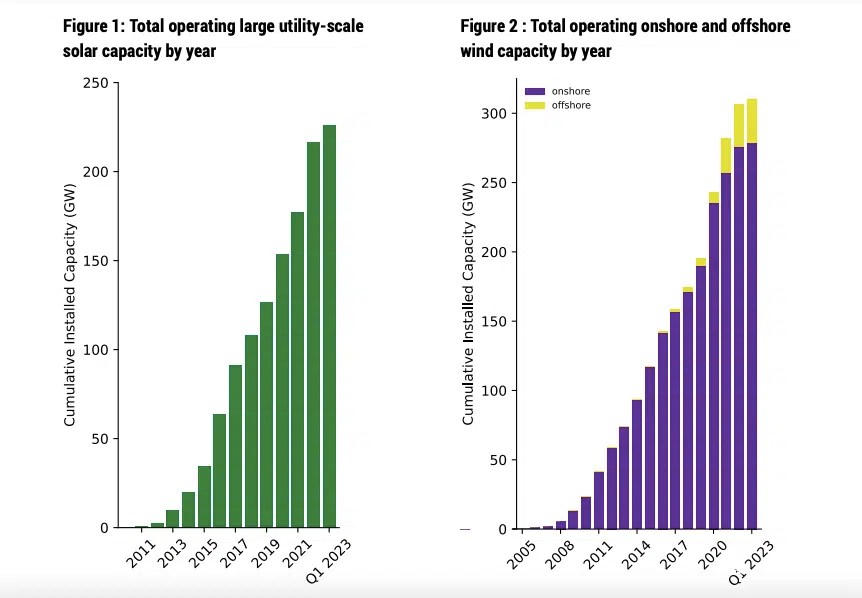
China leads the world in solar and wind energy capacity, and the numbers are staggering:
- In 2023, China installed 217 gigawatts (GW) of solar capacity, equivalent to powering 217 million households. This brought the country’s cumulative solar capacity to nearly 500 GW.
- In the same year, 76 GW of wind turbines were installed, exceeding the total wind capacity of the United States.
- China accounts for nearly two-thirds of the global increase in renewable energy capacity, according to the Global Energy Monitor (GEM).
Much of this growth stems from massive solar farms in the deserts and rooftop solar installations in urban areas. For instance, more than 500 million solar panels were added across China in 2023 alone.
Nuclear Power Expansion
China’s nuclear power sector has also seen exponential growth:
- As of 2023, China operates 77 nuclear reactors, with more under construction, making it second only to the United States in nuclear capacity.
- Electricity generation from nuclear power quadrupled over the past decade, rising from 98 terawatt-hours (TWh) in 2012 to 418 TWh in 2022.
China has embraced cutting-edge nuclear technologies, including small modular reactors and experimental designs, underscoring its ambition to become self-reliant in nuclear innovation.
Permanent Magnets and Rare Earths
China’s dominance in rare earths is critical for green technologies like EVs and wind turbines. Permanent magnets, a key component in these technologies, are produced primarily in China, giving the country a near-monopoly in this sector. This strategic advantage ensures China remains at the forefront of global renewable energy supply chains.
The Coal Paradox
Despite these achievements, coal remains a cornerstone of China’s energy mix. In 2023, China accounted for 95% of global coal plant construction, with new plants adding over 100 GW of capacity. However, there are signs of a slowdown: permits for new coal plants dropped to 9.1 GW in the first half of 2024, a significant decline from previous years.
China’s reliance on coal presents a paradox. While renewable capacity grows, coal-fired power plants continue to meet the surging energy demand driven by economic growth. In 2023, China emitted a record 12,290 megatons of CO₂, triple its emissions in 2000.
Global Impact of China’s Green Technology
China’s green-tech exports, particularly solar panels and EVs, play a pivotal role in the global climate transition:
- Over 95% of solar panels installed in the Netherlands are manufactured in China.
- Chinese EVs are increasingly popular in emerging markets, offering affordable options for countries transitioning to electric mobility.
However, Western nations are cautious about over-reliance on Chinese technology. Policies like the EU’s recent tariff increases on Chinese EVs aim to protect domestic industries, potentially spurring local innovation.
Balancing Progress and Challenges
China’s ambitious climate goals, including peaking CO₂ emissions by 2030 and achieving carbon neutrality by 2060, have driven significant investments in green technologies. However, to align with the Paris Agreement’s target of limiting global warming to 1.5°C, China must accelerate the phase-out of coal. The world cannot afford delays in this transition, given the urgency of the climate crisis.
Conclusion
China’s remarkable progress in renewable energy, EV adoption, and nuclear power sets a benchmark for the world. However, its dual role as a green leader and the largest CO₂ emitter underscores the complexity of the global climate transition. As China continues to electrify its economy and expand renewable capacity, the balance between green ambition and coal dependency will determine its long-term impact on the planet.
In a world increasingly defined by climate challenges, China’s actions offer both inspiration and lessons for countries striving to achieve sustainable development.

 About Energy & Water
Leave a comment